
Running a self-drive or rideshare car rental business means juggling a dozen moving parts at once: enquiries coming in from your website, WhatsApp, and phone calls; a fleet that needs to be tracked vehicle by vehicle; deposits and agreements that have to be collected and signed before every handover; rent that needs to be chased down every week; and fines, tolls, and maintenance that pile up in the background. The question most fleet owners eventually face isn’t whether to formalize this process it’s whether to keep doing it manually, or move to a car rental management software that automates it.
The Manual Way: Where It Breaks Down
Manual car rental management usually looks something like this:
- Enquiries land in a mix of WhatsApp chats, phone calls, and email, with no central record of who followed up or when.
- Vehicle availability lives in someone’s head or a shared spreadsheet that’s rarely up to date.
- Deposits are collected in cash or via ad-hoc bank transfers, with payment proof scattered across screenshots.
- Rental agreements are printed, signed physically, and filed away or worse, never formalized at all.
- Extending a rental, pausing it for a breakdown, or swapping a vehicle means manually updating multiple records and hoping nothing falls through the cracks.
- Invoices are created manually in Excel or Word, often after the fact rather than automatically when a rental starts or changes.
- Rent collection means calling or texting customers to remind them, then manually checking bank statements to confirm payment.
- When a fine or toll notice arrives weeks later, someone has to reconstruct which driver had which vehicle on that date.
- Vehicle servicing is tracked (if at all) on a whiteboard or a separate maintenance logbook that nobody checks until a car breaks down.
None of this is unworkable at a small scale a handful of cars and a hands-on owner can make it function. But every one of these steps is a place where things get missed, delayed, or double-handled as the fleet grows. And each missed step usually costs either revenue (an unpaid invoice, an unbilled extra day) or trust (a customer waiting on a signature link that never arrived).
The Automated Way: How Car Rental Automation Fixes This
This is where car rental business automation platforms like Moiboo change the day-to-day operation of a rental business. Rather than replacing one manual step with another tool, an automated rental management system connects every stage of the rental lifecycle sales, operations, collections, fines, maintenance, and accounting into one continuous workflow.
1. Enquiries flow straight into a CRM
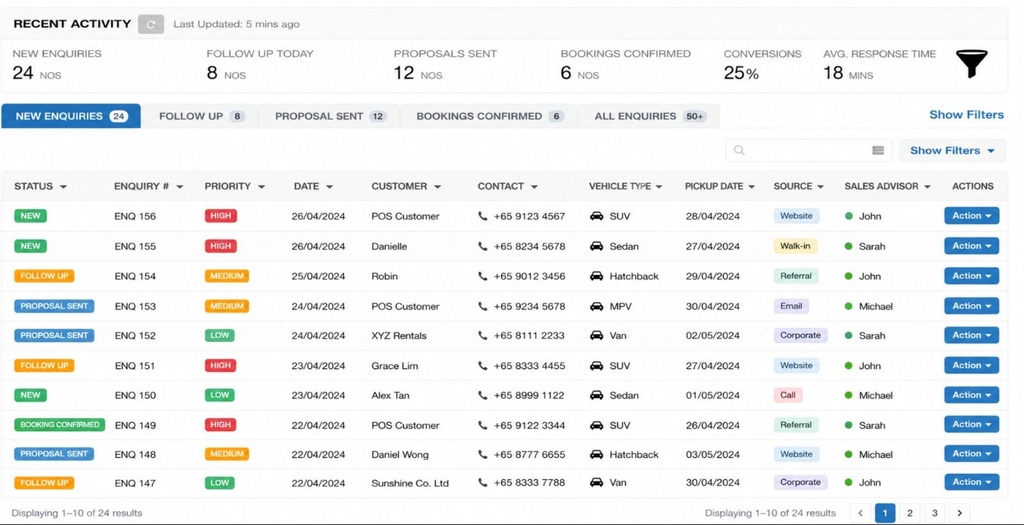
Moiboo integrates directly with your website. Short-term and long-term rental enquiries — each with their own input form — land automatically in a CRM as leads. A sales manager sees new enquiries, follow-ups due today, proposals sent, and confirmed bookings in one dashboard. Each lead gets assigned to a specific sales advisor with a follow-up date attached. Nothing sits unanswered in a chat thread.
2. Fleet availability is visible in real time
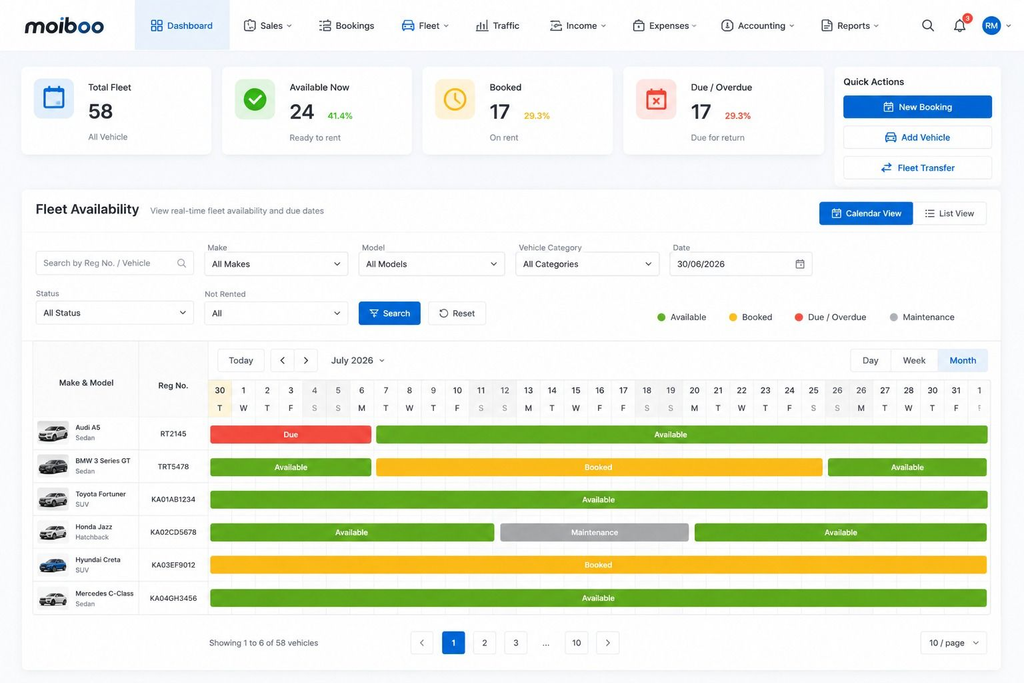
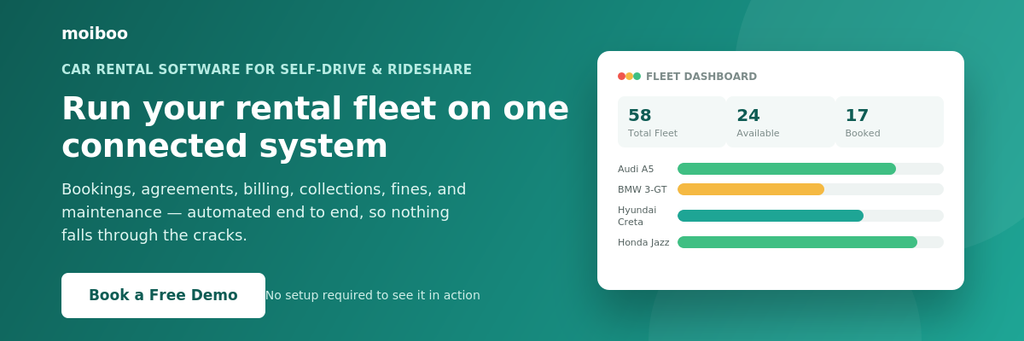
Not knowing which car is actually free causes some of the biggest manual errors. A digital car rental management dashboard shows total fleet size, vehicles available now, vehicles currently booked, and vehicles overdue or in maintenance. It updates live, with a calendar view showing exactly when each vehicle becomes free. Your team checks a screen instead of calling around.
3. Deposits and agreements go digital
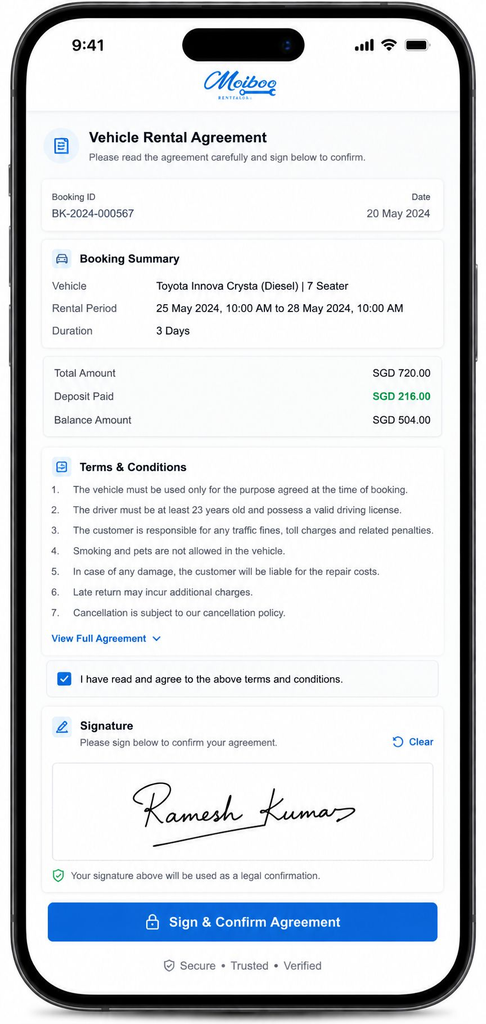
Rather than chasing payment screenshots and printed signatures, Moiboo sends an e-form to collect the deposit amount, payment method, and proof of payment, and generates the rental agreement automatically. That agreement is sent to the customer over WhatsApp, where they review the terms and sign directly on their phone turning a step that used to take a trip to the office into something completed before the car even leaves the yard.
4. Every operational change is a single action
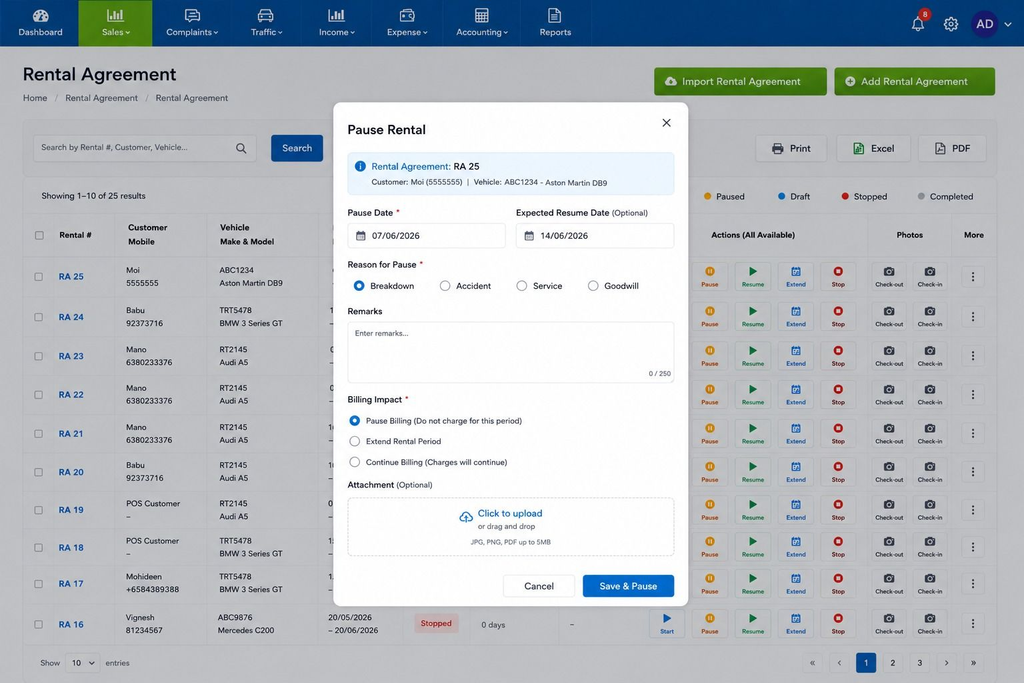
Once a rental is active, day-to-day changes are where manual systems lose track fastest. A breakdown pauses the rental. A customer requests an extension. An accident forces a vehicle swap. In an automated system, each of these becomes a controlled action. You pause with a reason and a billing impact do you stop billing, extend the period, or keep charging? You extend by days or to a specific date, with billing terms set upfront. It can even replace the vehicle mid-agreement without breaking the contract or losing the rental history. Check-out and check-in inspections capture timestamped photos, so you resolve vehicle condition disputes with evidence instead of memory.
5. Billing and invoicing happen automatically
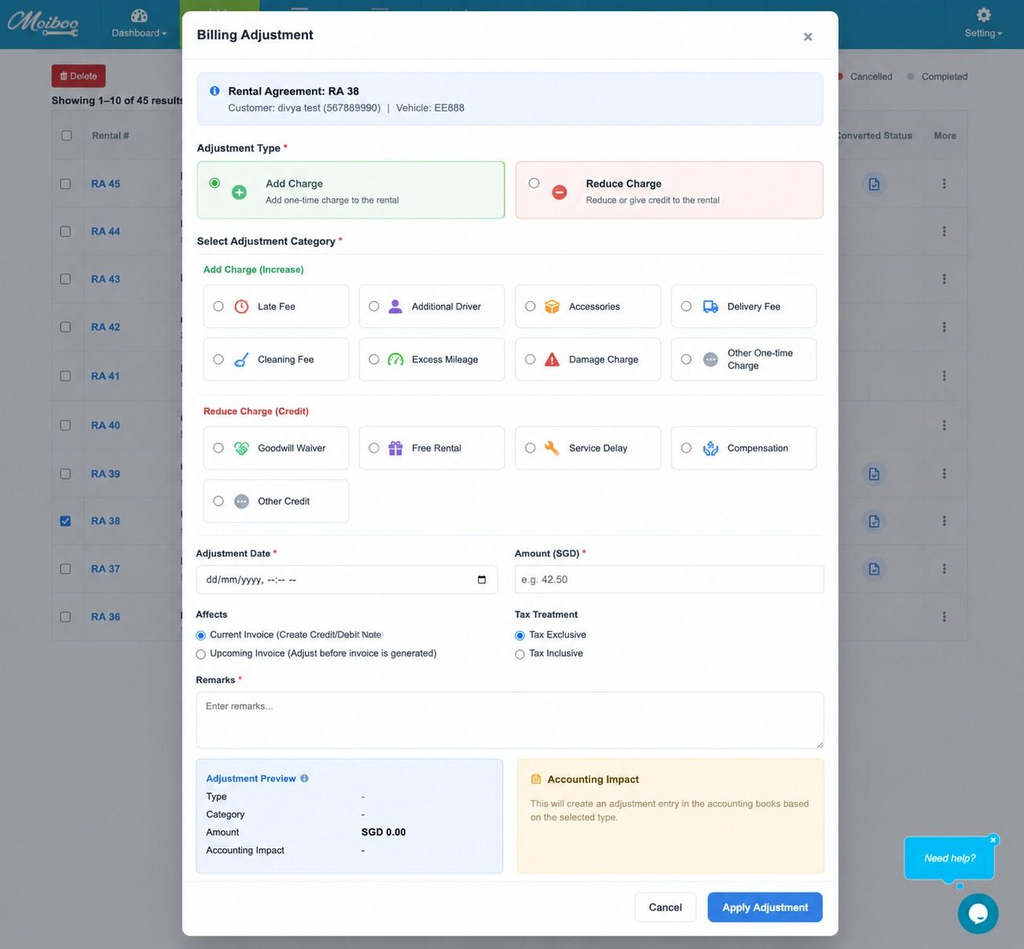
Manual invoicing usually happens after something has already changed — a late return, a waived fee, an extra day. With car rental management software, these become billing adjustments applied directly to the agreement: late fees, damage charges, goodwill waivers, free rental days. The system generates invoices and credit notes automatically based on those changes, instead of someone recreating them from scratch. For businesses that need compliant e-invoicing, Peppol-based invoicing sends, tracks, and confirms invoices directly through the Peppol network. You see real-time status from sent to accepted to paid.
6. Collections don’t rely on phone calls
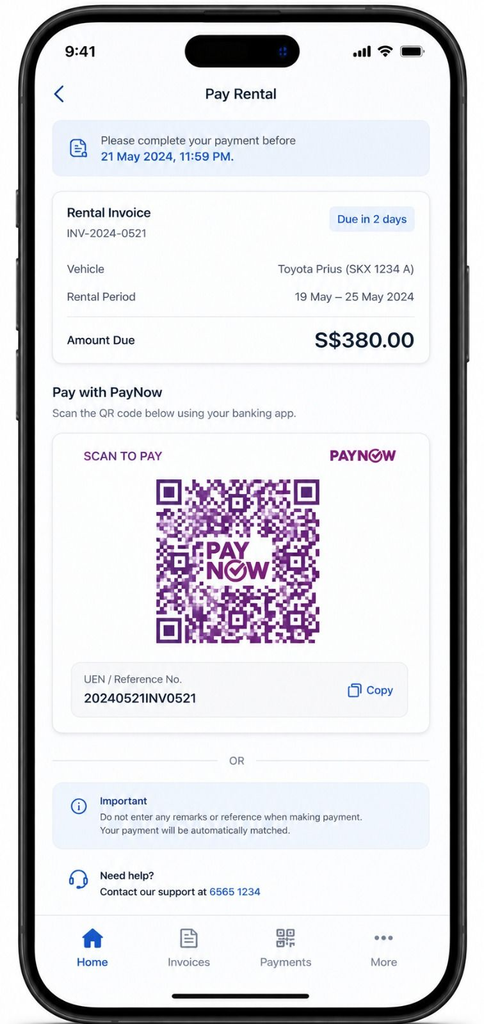
An automated rental management system gives customers their own app instead of a reminder call. It shows what’s due, when, and for which vehicle. Customers pay instantly via PayNow QR, bank transfer, or card. They can also set up e-GIRO for recurring payments. They see their full payment history without calling in. This alone removes a large share of the back-and-forth that manual collections require.
7. Fines and tolls are matched to the right driver automatically
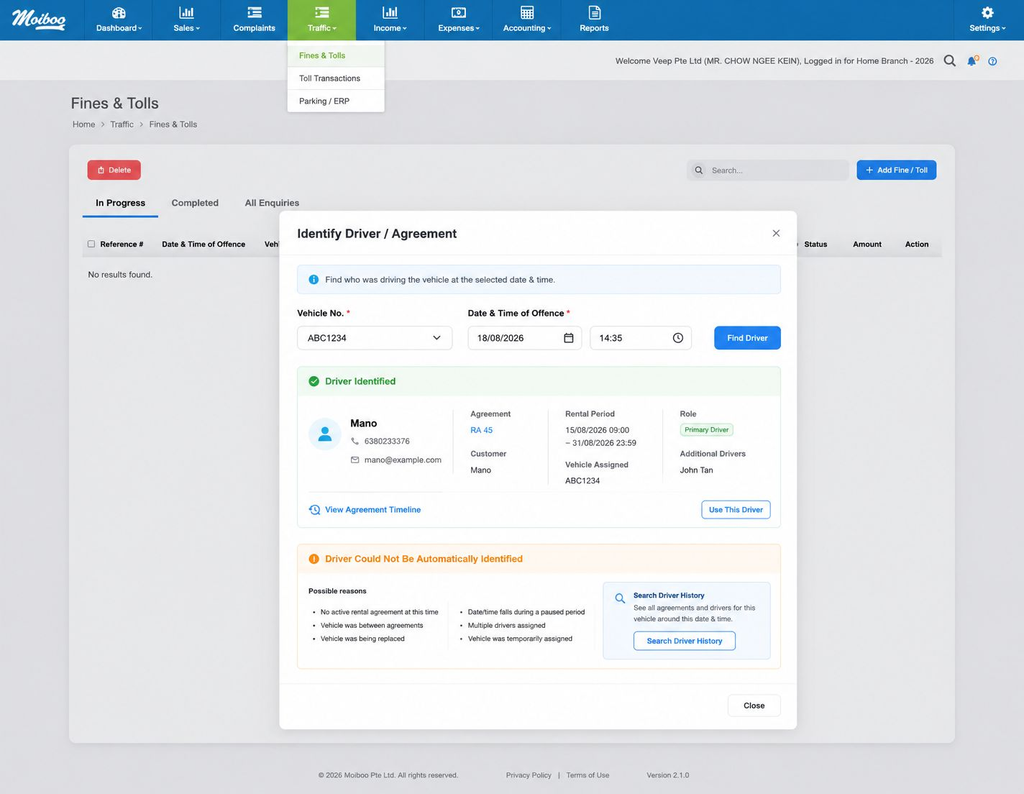
A fine or toll notice often arrives weeks after the fact. Manually figuring out who was driving which car gets slow and error-prone, especially with vehicle swaps or shared vehicles. Automated car rental automation checks the vehicle number and the date and time of the offence against the rental agreement history. It identifies the driver, the agreement, and the rental period automatically. Manual lookup only handles the genuinely ambiguous cases.
8. Maintenance doesn’t wait for a breakdown
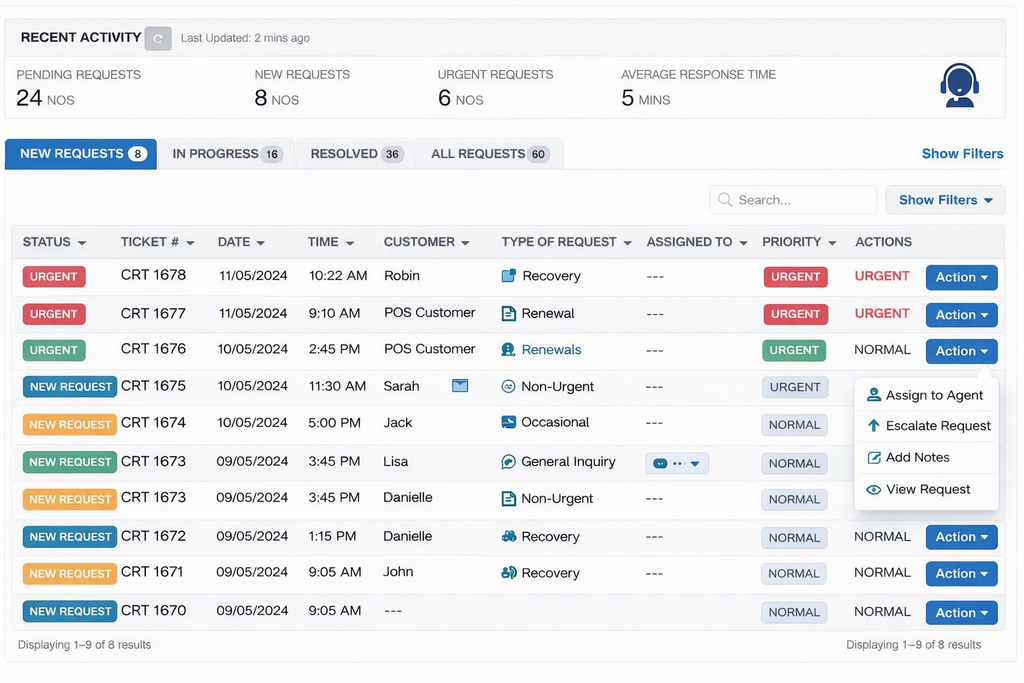
Service due dates and customer complaints are consolidated into a single queue instead of a logbook nobody checks, workshops submit quotes and job cards through their own app, and a customer care team reviews and approves the work closing the loop between “something is wrong with the car” and “it’s fixed and logged” without relying on someone remembering to follow up.
Why This Matters: The ROI of Automation
The case for automated car rental management isn’t really about replacing people it’s about removing the steps where revenue leaks out or customers lose confidence:
- Fewer missed follow-ups — every enquiry is tracked and assigned, not left in a chat thread.
- Fewer billing gaps — extensions, late fees, and damage charges are captured at the moment they happen, not reconstructed later.
- Faster cash collection — customers can pay instantly instead of waiting for a reminder call.
- Less time on fines and disputes — driver identification and check-in/check-out photos remove the guesswork.
- Better fleet utilization — real-time availability means fewer double-bookings and idle vehicles.
For a business running a handful of cars, manual car rental management can still work.
Making the Switch
If your rental business is still running on spreadsheets, WhatsApp threads, and paper agreements, the shift to automation doesn’t have to happen all at once. Platforms like Moiboo are built in modules starting with core operations and accounting, and adding sales & booking, collections, or maintenance and job cards as your business needs them so you can automate the parts causing the most pain first, rather than overhauling everything on day one.
The question isn’t really manual versus automated anymore. It’s how much longer manual processes can keep up with the fleet you’re trying to build.
Manual-vs-Automated-Car-Rental-Management.pptx by Ashwin Immanuel