

Managing car rental deposits, refunds, and security fees is one of the trickiest parts of running a car rental business. Deposit disputes are common and can damage customer trust, tie up staff time, and even lead to financial losses. This practical guide is designed for car rental owners and counter staff who handle deposits by bank transfer, cash, or card—often recording details on paper or in chat messages. If you’ve ever struggled to prove how much was paid, what was deducted, and what was refunded, this guide will help you tighten up your process, reduce disputes, and improve your car rental deposit management.
1. Why Deposits Cause So Many Disputes
Deposit disputes are a leading source of headaches for car rental businesses. Here’s why problems arise:
- Unclear terms: Customers aren’t always told exactly what the deposit covers, when it will be refunded, or what can be deducted.
- Poor record-keeping: Payments are sometimes noted only in chat threads or on scraps of paper, making it hard to prove who paid what.
- No proof of condition: Without photos or checklists showing the car’s state before and after rental, claims about damages are hard to resolve.
- Unrecorded deductions: Fees for cleaning, late return, or minor damage may be taken from the deposit, but unless these are logged with reasons, disputes are likely.
- Slow or undocumented refunds: Delays or missing proof of refund frustrate customers and lead to complaints.
By addressing these root causes with strong rental security deposit tracking and clear procedures, you can reduce the risk of disagreements.
2. Deposits, Security Deposits, and Fees: What Is What
Before improving your deposit process, clarify the different types of upfront payments:
- Deposit: An amount paid by the customer as security against damage, loss, or extra charges during the rental.
- Security Deposit: Sometimes used interchangeably with “deposit,” this is specifically the security amount held to cover damages or breaches.
- Fees (e.g., Booking Fee): Non-refundable amounts paid to secure the booking or cover administrative costs.
Terminology varies by business and country, so always define each term in your rental agreement. For the purposes of this guide, a “security fee” is simply an upfront security amount or fee—it’s not a separate feature, but part of how you manage vehicle rental deposits. Clear definitions prevent misunderstandings.
3. Step 1: Write the Deposit Terms Into the Agreement
Best Practice:
State deposit terms clearly in your rental agreement before taking any payment. The agreement should specify:
- The deposit amount (or how it is calculated)
- What the deposit covers (e.g., damages, cleaning, late returns)
- When and how it is refunded
- What deductions are possible, with examples
- The payment method
Use plain language, and remember that requirements for deposits and refunds vary by country. Always check your local rules or seek professional advice when setting your terms. Clear, upfront communication is the foundation of effective car rental deposit management.
4. Step 2: Collect and Record the Deposit
Best Practice:
When you collect the deposit, immediately record:
- The amount received
- The payment method (bank transfer, card, cash, etc.)
- Proof of payment (photo, receipt, or digital confirmation)
This eliminates confusion if there’s ever a question about what was paid.
How Moiboo Helps:
Moiboo’s Collect Deposit e-form lets you gather all deposit and payment details in one place. The form includes fields for the deposit amount, booking fee or collected amount, payment method (such as QR/wallet transfer, card, or cash), proof uploads (up to ten files), balance amount, and staff name. At the start of the rental, the Start Rental form’s Security Deposit section records the deposit amount, payment mode, reference or receipt number, notes, and attachments. This structured rental payment management ensures you have a clear record for every transaction.
5. Step 3: Keep the Deposit Visible on the Agreement
Best Practice:
Both staff and customers should be able to see at a glance how much was paid as a deposit and any balance still owed.
How Moiboo Helps:
Moiboo’s agreement view, accessible on the customer’s phone, shows the booking summary with the total amount, deposit paid, and balance right beside the terms and signature. This transparency is crucial for rental transaction tracking and helps prevent disputes by keeping everyone on the same page.
6. Step 4: Record the Vehicle’s Condition at Handover
Best Practice:
You can only deduct fairly from a deposit if you can prove the car’s condition before and after the rental. Always record:
- Photos of the vehicle (all sides, interior, dashboard/odometer)
- A checklist (fuel, tyres, interior, existing damage, documents)
- Odometer reading and fuel level
How Moiboo Helps:
Moiboo’s check-out and check-in inspections let you capture photos and fill out checklists for fuel, tyres, interior, damage, and documents. The Start Rental form records the odometer, fuel level, and driver details (licence number and expiry date). This robust vehicle condition documentation supports security fee tracking and protects your business in case of disputes.
7. Step 5: Record Charges and Waivers During the Rental
Best Practice:
Anything that changes what the customer owes—such as a late fee, extra mileage, cleaning charges, or damage—should be recorded with a clear reason. Likewise, if you waive a charge (as a goodwill gesture), document it.
How Moiboo Helps:
Moiboo’s Billing Adjustment feature allows staff to add or waive charges, with fields for remarks and the option to choose whether the adjustment affects the current or upcoming invoice. This creates a credit or debit note and ensures all changes are traceable. While adjustments are not automatically deducted from the deposit, careful recording supports fair car rental refund management and adds clarity for both parties.
8. Step 6: Close the Rental and Refund the Deposit
Best Practice:
When the car is returned:
- Record the return (noting early return, repossession, or contract completion)
- Compare check-in and check-out vehicle condition (with photos and checklist)
- List any deductions allowed by the agreement, with supporting evidence
- Issue the final invoice
- Refund the remaining deposit balance to the customer
- Provide a receipt and keep a written record of each step
How Moiboo Helps:
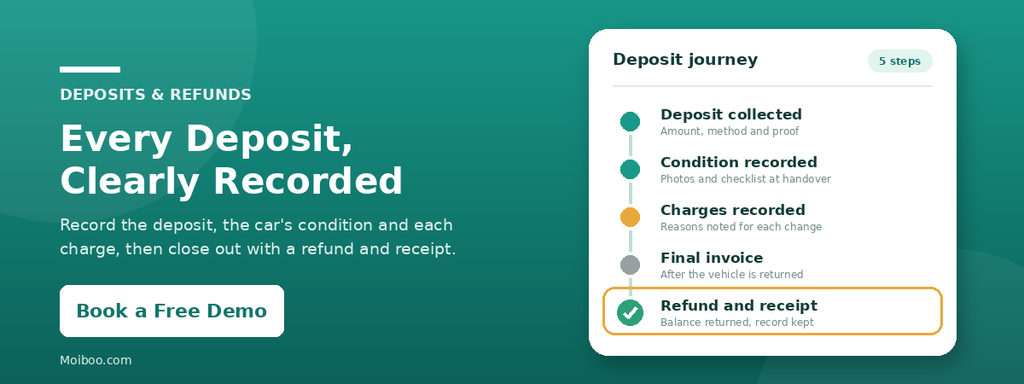
Moiboo’s operations flow guides you from Stop Rental (with a reason for ending) through check-in, vehicle return, and final invoice to deposit refund or receipt. This clear process makes rental deposit refunds straightforward and ensures each step is documented for smooth car rental financial management.
9. Handling Deposit Disputes Fairly
Best Practice:
If a customer questions a deduction or refund, respond with documentation:
- The signed agreement, showing clear terms
- Photos and checklists from check-in and check-out
- A record of any charges, waivers, or adjustments (with remarks)
- Written explanations for each deduction
Record any goodwill waivers you grant. This evidence-based approach is the best way to resolve disputes quickly and fairly—without giving legal advice.
10. Tracking Deposit Transactions (Rental Transaction Tracking)
Best Practice:
Every deposit, charge, payment, and refund must be traceable to a specific rental. Good rental transaction tracking supports audits and helps resolve questions.
How Moiboo Helps:
Moiboo’s agreement timeline acts as an event log for each rental, recording when rentals start, pause, or have the vehicle replaced, along with the date, time, and staff involved. This timeline can be downloaded for records. The customer app shows invoices and payment history, while the Accounts flow covers invoices, credit notes, debit notes, receiving and making payments, and bank reconciliation. This combination supports comprehensive rental security deposit tracking while keeping records organized.
11. Common Mistakes With Rental Deposits
Learn from others’ errors:
- Unclear deposit terms: Failing to spell out what the deposit covers leads to confusion.
- No proof of payment: Not keeping receipts or payment confirmations makes disputes difficult to settle.
- Mixing deposits with rental payments: Deposits should be recorded and tracked separately from normal rental fees.
- Skipping vehicle condition checks: Without clear before-and-after records, it’s hard to justify deductions.
- Unrecorded deductions: Taking fees from a deposit without written reasons is a recipe for conflict.
- Slow refunds: Delays or missing documentation frustrate customers and damage your reputation.
- Keeping records only in chat threads: Important details can be lost, misfiled, or deleted.
Avoiding these mistakes is key for effective car rental deposit management.
12. A Deposit Checklist
At the Start of the Rental:
- State deposit terms clearly in the agreement
- Collect and record the deposit with payment method and receipt
- Record vehicle condition with photos and checklist
During the Rental:
- Log any additional charges or waivers, with reasons
- Keep all adjustments documented and linked to the rental
At the End of the Rental:
- Record the vehicle’s return condition (with photos and checklist)
- Compare with the initial record
- List and explain any deductions with evidence
- Issue the final invoice
- Refund the balance with a receipt and keep a record
FAQ: Car Rental Deposit Management
A: The terms are often used interchangeably. Generally, a deposit is an amount paid upfront as security for potential damage, loss, or extra charges. A security deposit specifically refers to that security amount. Define these terms clearly in your agreement to avoid confusion.
A: The amount depends on the vehicle, your business policy, and local regulations. There is no universal figure—check what’s appropriate for your fleet and market.
A: Refund timelines vary by business, payment method, and local requirements. State your policy clearly in the agreement and ensure it aligns with any applicable laws.
A: Yes, if your agreement allows for this and you can provide evidence (such as before-and-after photos and a checklist) to justify the deduction.
A: Keep a record of the payment (receipt or bank confirmation), the signed agreement, and any documents or photos related to deposit deductions or refunds.
Conclusion
Good car rental deposit management means setting clear terms, recording every payment and vehicle condition, documenting all changes, and closing out with a transparent refund and receipt. By following these steps and using tools like Moiboo for rental security deposit tracking, car rental refund management, and rental payment management, your business can avoid disputes and maintain customer trust.