Managing more than one car rental branch brings new challenges and, with the right approach, new opportunities. If you’re an owner or operations manager growing your car rental business from a single branch to multiple locations, this practical guide will help you build control and consistency across locations without micromanaging every detail.
This guide covers step-by-step practices for multi-location car rental management, with clear explanations, common mistakes, and honest insights into how Moiboo’s car rental management system can help.
1. Why Managing More Than One Location Is Different
Running a single car rental branch is complex, but adding a second or third location changes everything. Suddenly, vehicles move between branches sometimes without a record. Each team develops its own habits, and paperwork or digital records start to live in different places. As the owner, you lose the single view you once had: it’s no longer obvious where cars are, which branch has overdue returns, or how each location is performing. Without a centralized rental management approach, things can quickly become chaotic.
2. What to Centralize and What to Keep Local
Centralize the essentials:
- Fleet register: Keep one master list of vehicles for car rental fleet tracking and multi-location vehicle tracking.
- Customer and enquiry records: All customer data and enquiries should feed into a single system.
- Agreement and invoice templates: Use the same formats everywhere.
- Inspection checklists: One standard for all handovers and returns.
- Pricing rules and reporting: Set centrally for consistency.
Keep local:
- Handovers and customer service: The personal touch stays with each branch team.
- Day-to-day staffing: Each location manages its own schedule and on-the-ground issues.
Centralized rental management means that vital information what cars you own, who your customers are, and how your business is performing lives in one place, visible to everyone who needs it. Local teams focus on personal service and operations, not spreadsheets and reporting.
3. Step 1: Keep One Fleet Register
A common pitfall in multi-location rental operations management is letting each branch keep its own inventory spreadsheet. This leads to confusion, double-bookings, and lost vehicles. Best practice is to create a single, shared fleet register where every car appears once, with a record of its make, model, registration number, and category. That way, rental inventory management doesn’t depend on local records.
How Moiboo helps: The Moiboo dashboard has an Add Vehicle quick action, and the fleet list shows each vehicle’s details. Every vehicle exists in one list, viewable by the whole team.
4. Step 2: See Availability Across the Whole Fleet
When staff at any location can’t see the full picture, they risk over-promising or missing revenue opportunities. Multi-branch rental software should let your team see, at a glance, which cars are available now, which are booked, due back, or in maintenance, no matter where the vehicle is.
How Moiboo helps: The fleet dashboard shows counts for the total fleet, available vehicles, booked cars, and those due or overdue. It includes a calendar and list view, which can be filtered by registration number, make, model, vehicle category, date, and status. This gives the whole team a real-time view of multi-location vehicle tracking and availability.
5. Step 3: Record the Branch on Every Rental
To keep track of your vehicles, every rental agreement should state which location the car was handed out from and, if different, where it was returned. This avoids cars slowly drifting from branch to branch without anyone noticing.
How Moiboo helps: The Start Rental form records the branch or location, along with other key details such as start date and time, odometer reading, fuel level, and driver information. Your rental enquiry form can also ask for the customer’s pickup location, helping you manage demand and logistics.
6. Step 4: Move Vehicles Between Branches Deliberately
Untracked vehicle transfers are a major source of confusion and lost revenue in rental operations management. If a car moves from Branch A to Branch B without a record, your fleet counts and availability are instantly out of sync. Over time, some branches end up with too many cars, others with too few, and vehicles can’t be found when needed.
Every vehicle transfer should be logged: who moved it, when, and in what condition. Regularly review the balance of cars between branches to spot imbalances before they hurt your business.
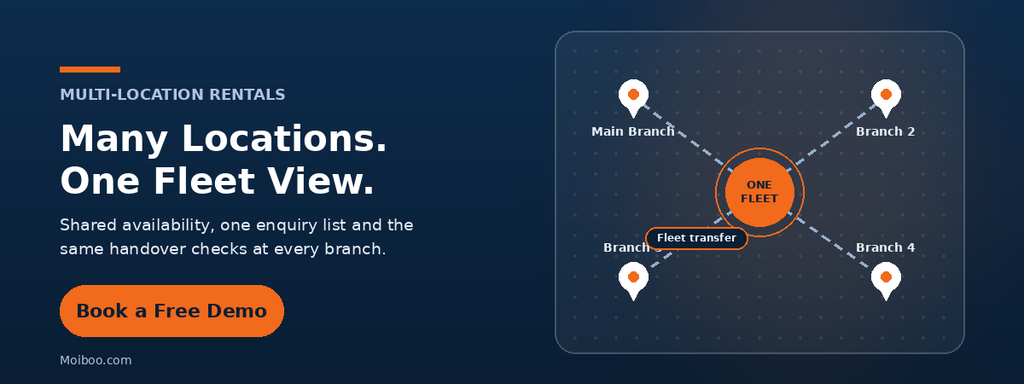
How Moiboo helps: The dashboard provides a Fleet Transfer quick action, making it easy to record vehicle movements between locations.
7. Step 5: Hold Every Branch to the Same Handover Standard
Inconsistent inspection and handover processes create disputes and unpredictable customer experiences. For true consistency, use one inspection checklist with the same steps and require photos in the same order at every branch. This way, if a car is handed over at one location and returned at another, you can fairly compare its condition.
How Moiboo helps: The check-out and check-in inspection uses a mobile checklist covering fuel level, tyres, interior, damage, and documents, supported by photos. Photos are stored with the rental agreement and are downloadable as a set, making audits and comparisons straightforward.
8. Step 6: Handle Enquiries and Follow-Up in One Place
A common mistake is letting each branch handle its own enquiries, often only by whoever answers the phone. This leads to lost leads and uneven customer service.
How Moiboo helps: The CRM list brings all enquiries into one place, with fields for status, priority, vehicle type, pickup date, source, and assigned sales advisor. Sales managers can assign leads, set follow-up dates, and see summaries of new enquiries, follow-ups due today, proposals sent, bookings confirmed, conversions, and average response time. This centralization keeps your sales process consistent and ensures no enquiry is missed.
9. Step 7: Centralize Agreements, Invoicing and Payments
Having each branch use its own agreement and invoice templates creates confusion and makes it impossible to see what the whole business is owed. A centralized approach ensures uniform agreements, invoicing, and payment records.
How Moiboo helps: The rental agreement list shows each rental’s status, period, and next invoice date. Invoices and credit notes are created automatically from agreement updates, and the accounts flow covers all key financial actions: invoices, credit and debit notes, expenses, payments, and bank reconciliation. This makes car rental reporting software effective across all branches.
10. Step 8: Report Across Locations (Car Rental Reporting Software)
To manage a growing business, you need to see more than just day-to-day bookings—you need to track performance across all locations. Key measures include:
- Fleet utilization
- Rentals and revenue per branch
- Vehicles off the road (in maintenance or overdue)
- Overdue returns
- Enquiry conversion rates
These figures help you spot bottlenecks, underperforming branches, and opportunities for growth. They are measures to track and review, not targets to expect in every business.
How Moiboo helps: The dashboard shows fleet counts, while the CRM summary includes enquiry statistics. These tools give you visibility into your business’s overall health.
11. Keeping Teams Consistent Across Branches
Consistency is the foundation of scalable rental operations management. Document your standards (for checklists, agreement terms, and vehicle transfers), train every branch the same way, and review a sample of records from each location every month. This helps catch errors early, reinforces good habits, and supports a culture of accountability.
12. Common Mistakes When Managing Several Locations
- Maintaining separate spreadsheets for each branch
- Moving vehicles between branches without a record
- Using different checklists at different locations
- Handling enquiries only by whoever answers the phone
- The owner only finds out about issues from customer complaints
Avoiding these mistakes is easier with multi-branch rental software and clear processes.
13. A Weekly Multi-Branch Routine
Build a simple, repeatable routine to keep your growing business on track:
- Review where each vehicle is located
- Check due and overdue returns
- Look at enquiries waiting for follow-up
- Sample a few inspection records from each branch
- Review any overdue payments
This helps spot issues early and keeps your management hands-on but not overwhelmed.
FAQ: Multi-Location Car Rental Management
When you open a second branch, or even plan to, it’s time to move to a centralized car rental management system. Manual tools and spreadsheets rarely scale beyond one location.
Every vehicle should be listed in a single fleet register, and every rental should record the branch it started from. This makes tracking and balancing your fleet much simpler.
Set clear policies on whether you allow one-way returns. If you do, make sure each rental agreement records the pickup location and, if possible, the return location, and ensure vehicles are transferred in your system as soon as possible.
Yes, a modern car rental management system like Moiboo brings together your fleet, bookings, agreements, customer records, and reporting, so you can manage multiple branches through one platform.
Write down your processes, checklists, agreement terms, and transfer procedures train every team the same, and regularly review records from each branch
Conclusion
Managing multiple car rental locations works best when you centralize the essentials fleet, enquiries, agreements, and standards while allowing each branch to focus on delivering great local service. With the right car rental management system in place, you can control your growing business without micromanagement.